
Explosives may be characterised by describing a pressure curve as a function of specific volume. One such equation of state is the Jones-Wilkins-Lee (JWL) pressure – volume expansion relationship [1]:

For each JWL pressure calculated using this equation there is also an experimental estimate  . In the first characterisation approach, the pressure as a function of expansion is characterised in isolation using differential evolution within specific allowable parameter bounds. If the unknown vector is taken as
 ![x=\left[A,\,B,\,C,\,R_{1},\,R_{2},\,\omega\right]](https://www.jvrensburg.com/wp-content/ql-cache/quicklatex.com-bf176af2d3c3b695e908e454b968cc1f_l3.png "Rendered by QuickLaTeX.com") , the objective function is constructed as the sum of the absolute fractional difference between the calculated and experimental pressure values
, the objective function is constructed as the sum of the absolute fractional difference between the calculated and experimental pressure values

subject to the bounds or constraints
![c_{i}\left(x\right)=\begin{cases} A=x_{1} & \in[250,400],\\ B=x_{2} & \in[2,5],\\ C=x_{3} & \in[0.5,2],\\ R_{1}=x_{4} & \in[2,6],\\ R_{2}=x_{5} & \in[0.7,1.5],\\ \omega=x_{6}-1 & \in[0.2,0.4]. \end{cases}](https://www.jvrensburg.com/wp-content/ql-cache/quicklatex.com-9d5b992352f05a5f133efa317301c44d_l3.png "Rendered by QuickLaTeX.com")
In this case the minimum objective function value was found on a few of the constraint boundaries  ,
,  ,
,  ,
,  and
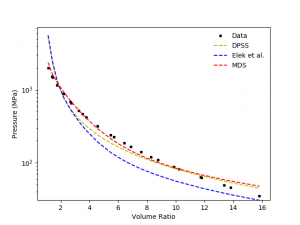
and  resulting in the fit between the JWL curve (red) and the data points. In this figure, the fit between the originally given parameter values in yellow and those found by Elek et al. [2] in blue are also compared.
Energy Balance and Chapman-Jouguet conditions
Following the work of Elek et al. [2], the JWL energy at  is calculated based on the values of A, B, C,
  ,
,  and
and  using:
 .
.
The JWL parameters should further satisfy three conditions at the Chapman-Jouguet point:
- Pressure (
 ) at the at the Chapman-Jouguet expansion ratio (
 ):
):  should be equal to the pressure value using the JWL Equation, i.e.:
- The derivative of the JHL pressure with respect to the volume ratio of the expansion should match the slope of the Rayleigh line

- Internal energy of detonation at the CJ point
 should be equal to the JWL calculated energy value:
The constraints at the CJ point can be exploited to reduce the number of unknowns during numerical optimisation. If \rho_{0}, D and V_{CJ} are given or known quantities, the three unknowns A, B and C follow from a candidate R_{1}, R_{2} and \omega solution by solving the system of equations using Equations~([eq:PCJ]), ([eq:PCJ0]) and ([eq:ECJ]):
\left\{ \begin{array}{c}
A\\
B\\
C
\end{array}\right\} =\left[\begin{array}{ccc}
\exp\left(-R_{1}V_{CJ}\right) & \exp\left(-R_{2}V_{CJ}\right) & V_{CJ}^{-\left(1+\omega\right)}\\
R_{1}\exp\left(-R_{1}V_{CJ}\right) & R_{2}\exp\left(-R_{2}V_{CJ}\right) & \left(1+\omega\right)V_{CJ}^{-\left(2+\omega\right)}\\
\exp\left(-R_{1}V_{CJ}\right)/R_{1} & \exp\left(-R_{2}V_{CJ}\right)/R_{2} & V_{CJ}^{-\omega}/\omega
\end{array}\right]^{-1}\left\{ \begin{array}{c}
\rho_{0}D^{2}\left(1-V_{CJ}\right)\\
\rho_{0}D^{2}\\
E_{0}+\frac{1}{2}\rho_{0}D^{2}\left(1-V_{CJ}\right)^{2}
\end{array}\right\} so that the CJ conditions are satisfied exactly.
References
[1] Dobratz BM and Crawford PC (1985) LLNL Explosives Handbook: Properties of Chemical Explosives and Explosive Simulants. University of California, Lawrence Livermore National Laboratory, Report UCRL-5299, Rev.2.
[2] Elek PM, Dzingalasevic VV, Jaramaz SS and Mickovic DM (2015) Determination of Detonation Products Equation of State from Cylinder Tests: Analytical Model and Numerical Analysis , Thermal Science, 19(1):35-48.